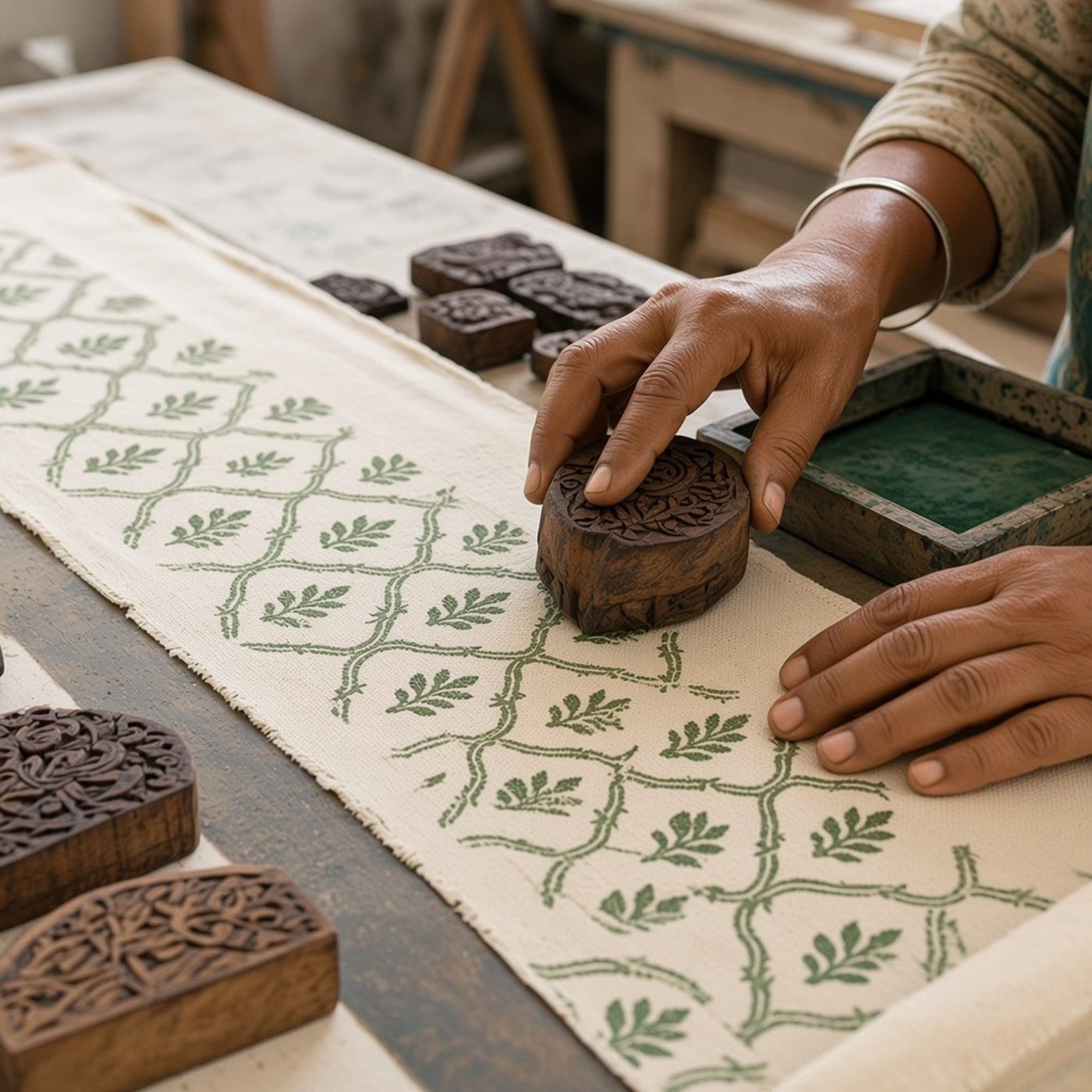
A hand block-printed tablecloth does not look quite like a machine-printed one, and that is the point. Each repeat is pressed by hand from a carved wooden block, so the pattern has a slight, living variation from one impression to the next. Our block-print family-name tablecloth is printed in this way in Jaipur, in a sage green floral trellis on cotton, then finished with your family name or initials embroidered in one corner.
The method itself is much older than any one workshop. Two towns just outside Jaipur, Sanganer and Bagru, are the names most often attached to Rajasthani block printing, and their traditions still shape how the work is done.
Sanganer and Bagru: two neighbouring traditions
Sanganeri printing is usually recognised by a light ground — white or a very pale cream — and by fine, naturalistic floral work: small sprigs and butis, trailing creepers (bel), and net-like jaal patterns. The Chippa community, whose name comes from chhapai, “to print”, has long been associated with the craft in this part of Rajasthan. Incredible India traces Sanganeri printing back to artisans who settled in Sanganer, Bagru and Jahota, and notes that designs are carved into seasoned teak blocks, dipped in dye and pressed onto stretched cloth, which is then dried in the sun.
Bagru, a short way west of Jaipur, is often described in contrast. The cloth is traditionally treated with harda (myrobalan), a tannin bath that leaves a soft yellowish or ivory ground and helps later colours bind. Motifs tend to be bolder and more rhythmic. Bagru is especially known for syahi-begar printing — iron black and alizarin or madder red — and for dabu, a mud-resist technique. In dabu work, a paste of clay and other binders is printed onto the cloth, sometimes dusted with sawdust so it does not smudge, and the cloth is then dyed, often in indigo. When the mud is washed away, the protected shapes remain lighter, sometimes with a fine crackle where the dye crept into the dried resist.
We do not attach a Sanganer or Bagru village label to our own tablecloth. It is hand block-printed in Jaipur, in a floral trellis that sits closer to the lighter, garden-like character of Sanganeri work than to a dark indigo dabu ground. Knowing those two traditions, though, is the best way to understand the tools and the pace of the craft.
Carved wooden blocks
The block is the printing plate. It is carved from seasoned hardwood, commonly teak or sheesham (Indian rosewood), with the design cut in relief on the face that meets the cloth. A single pattern usually needs more than one block: an outline block, often called rekh, and one or more filler blocks (gadh or datta) for the areas of colour. Each colour in the design has its own block.
Before printing, the cotton is washed and prepared so the dye will take evenly. The cloth is then pinned smoothly along a long printing table, often over a felt padding, so that it cannot creep or wrinkle. Dye or pigment sits in a tray, spread on a cloth pad. The printer dips the block, aligns it by eye — sometimes with small registration marks — and strikes it down with a steady hand. The work generally travels from left to right, and one printer may keep to a single colour while another follows with the next block. This is slow, attentive work. A tablecloth of about 150 × 250 cm, large enough to seat six to eight, means a great many impressions before the trellis is complete.
After printing, the cloth is dried, often in the sun, and then finished. Traditional sequences include steaming or washing to fix the colour, a further drying, and a press. Weather matters: humid or short winter days slow the drying, and wooden blocks are looked after carefully so they do not swell or warp.
Natural dyes, and the character of a handmade repeat
Historically, both Sanganer and Bagru worked with plant and mineral colours: indigo for blue, madder or alizarin for red, turmeric for yellow, pomegranate rind, and a deep black made by fermenting rusted iron with jaggery. Our tablecloth is listed as cotton with natural, AZO-free dyes, in a soft sage rather than the classic red-and-black of syahi-begar. The first wash should be done cold and separately, as the care card explains, because block-print dyes benefit from a gentle start.
What you will also notice, and should, is a little movement in the pattern. A hand-struck block never lands in quite the same way twice. That gentle variation is not a flaw; it is how you can tell the trellis was printed, not rolled off a machine.
From printed cloth to a table that is yours
Printing is only half of our piece. Once the floral trellis is complete, we add a personal inscription: a family name or initials, up to twenty characters, embroidered in sage script in one corner. Please check the spelling at checkout; we embroider exactly what you type. Other sizes can be requested if 150 × 250 cm is not quite right for your table.
The same respect for block-printed cotton runs through our heritage patchwork monogram throw, which uses hand block-printed panels alongside embroidered ones, finished with a personal monogram patch. For the table itself, the printed cloth sits happily with our embroidered Christmas monogram napkins and holly table runner.
The tablecloth is made to order in two to three weeks, then shipped, and arrives in our cream gift box with tissue, ribbon, a wax seal and a care card. You can order it, and the rest of the collection, from Lumen Atelier Textiles. Every piece is 20% off until 12 December 2026, with the code CHRISTMASSALE20.